
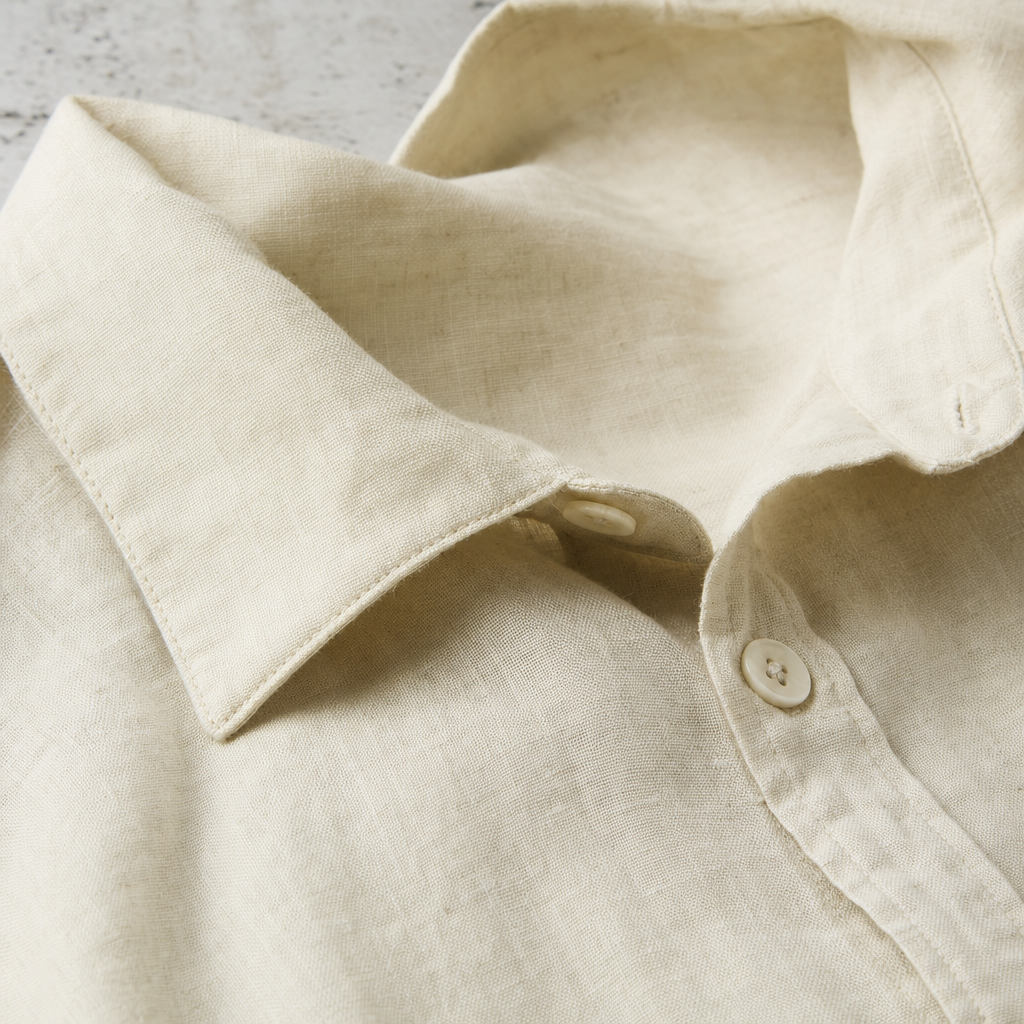
Fill a basin with lukewarm water — not hot — and add one tablespoon of hair conditioner or baby shampoo. Submerge the shrunken linen shirt and soak for 15–20 minutes. The conditioner relaxes the fibre structure, making the fabric temporarily pliable. Remove the shirt, press out the water gently (no wringing), then stretch the fabric slowly while damp: hold the hem in one hand and the shoulder in the other, and pull steadily lengthwise for 30-second intervals, working across the full width of each panel. Lay flat on a dry towel to dry, pulling the fabric gently toward its original dimensions as it dries. You can typically recover 50–70% of the shrinkage. Heat-dryer shrinkage is harder to reverse than hot-water shrinkage.
The shirt came out of the dryer and it was two sizes smaller. The sleeves end above the wrist now. The hem rides above the hip. You know what happened. You are not certain it is fixable, but you fill the basin anyway.
Can you permanently unshrink linen?
Partially. The conditioner-soak method works by temporarily relaxing the hydrogen bonds in the linen fibre, allowing the yarn to extend back toward its original length. The recovery is rarely 100% — expect 50–70% of the original dimensions. The shirt will not return to its factory size, but it can often be restored to wearable dimensions. A shirt that shrank 5% (roughly 3–4cm in the body) after a dryer cycle can typically be brought back to within 1–2cm of original with patient stretching. A shirt that shrank 10% or more (from repeated dryer use) has less recoverable fibre and will yield a smaller improvement.
Does the conditioner method work on all linen?
It works on pure linen and linen blends where the majority fibre is linen (linen-cotton, linen-viscose). Blends with wool require more care — wool can felt when handled wet and warm. For a linen-cotton blend (the most common), the conditioner method is safe. Pure linen responds best because the hollow bast fibre relaxes quickly in water with a surfactant. Use lukewarm water, not cold — the fibre needs slight warmth to relax, but not enough heat to cause further shrinkage.
How do you stretch linen back to size?
Work systematically across the garment while it is damp and limp from the soak. Start with the body: hold the hem and shoulder seam and pull lengthwise, then hold the side seams and pull width-wise. Move to the sleeves: hold the cuff and the armhole and pull along the sleeve length. For the collar: hold each collar point and pull gently outward while supporting the collar stand. Lay flat after stretching and pin to a towel at the target dimensions if needed — pin the hem at its target length and each sleeve end, then allow to dry completely without moving the garment.

What if the linen won't stretch back?
Repeat the process. A second soak in fresh conditioner-water, followed by another round of stretching, can recover more dimensions than a single treatment. For severely shrunken linen — from multiple dryer cycles — three to four treatments may be necessary, each recovering a small additional amount. At some point the fibre is permanently deformed and will not yield further. The practical limit: if the shirt shrank more than 15% (approximately one full size), it is likely unrecoverable to the original dimensions.
How do you prevent linen from shrinking in the first place?
The three rules that prevent almost all linen shrinkage: (1) Wash in cool water — 30°C maximum. (2) Never tumble dry. (3) Hang damp on a wooden hanger immediately after washing. These rules prevent shrinkage, preserve colour, and extend the life of the fabric. The dryer is the primary risk: a single standard-heat cycle can cause 5–8% shrinkage that is only partially recoverable. Pre-washed linen, like Squalo Roma shirts, has already completed its primary shrinkage cycle — cool water washing keeps it stable indefinitely.
Frequently asked questions
Can you use fabric softener instead of conditioner to unshrink linen?
Yes — fabric softener contains similar surfactants and works the same way as hair conditioner for relaxing linen fibres. Use the same quantity (one tablespoon per basin) and the same process. Avoid fabric softener as a regular linen-care product, however — repeated use coats the fibres and reduces the breathability that makes linen valuable.
How long does it take to unshrink a linen shirt?
The soak takes 15–20 minutes; the stretching takes 5–10 minutes; the flat drying takes 1–3 hours depending on humidity. Total active time is under 30 minutes, but allow half a day before wearing the shirt to ensure it has dried flat and fully.
Will unshrinking a linen shirt damage the fabric?
The conditioner soak does not damage linen. The main risk is stretching too aggressively while wet — pulling at the fabric rather than easing it. Slow, steady pressure for 30-second intervals is more effective and safer than pulling hard. The fibre relaxes incrementally; force does not accelerate the process.
My shirt shrank in length but not width — is this normal?
Yes. Linen shrinks primarily in the warp direction (length) because the warp threads are under tension during weaving and relax when freed by heat. Width-shrinkage is usually smaller. Most linen shrinkage complaints are about shirt body length and sleeve length — the width of the shirt typically remains close to original dimensions even after significant heat exposure.
Looking for linen worth the care? See Squalo's linen trousers and knit polos, or a full outfit at Shop the Look.
Read next: Men's Linen Trousers and Business Casual Trousers.


