
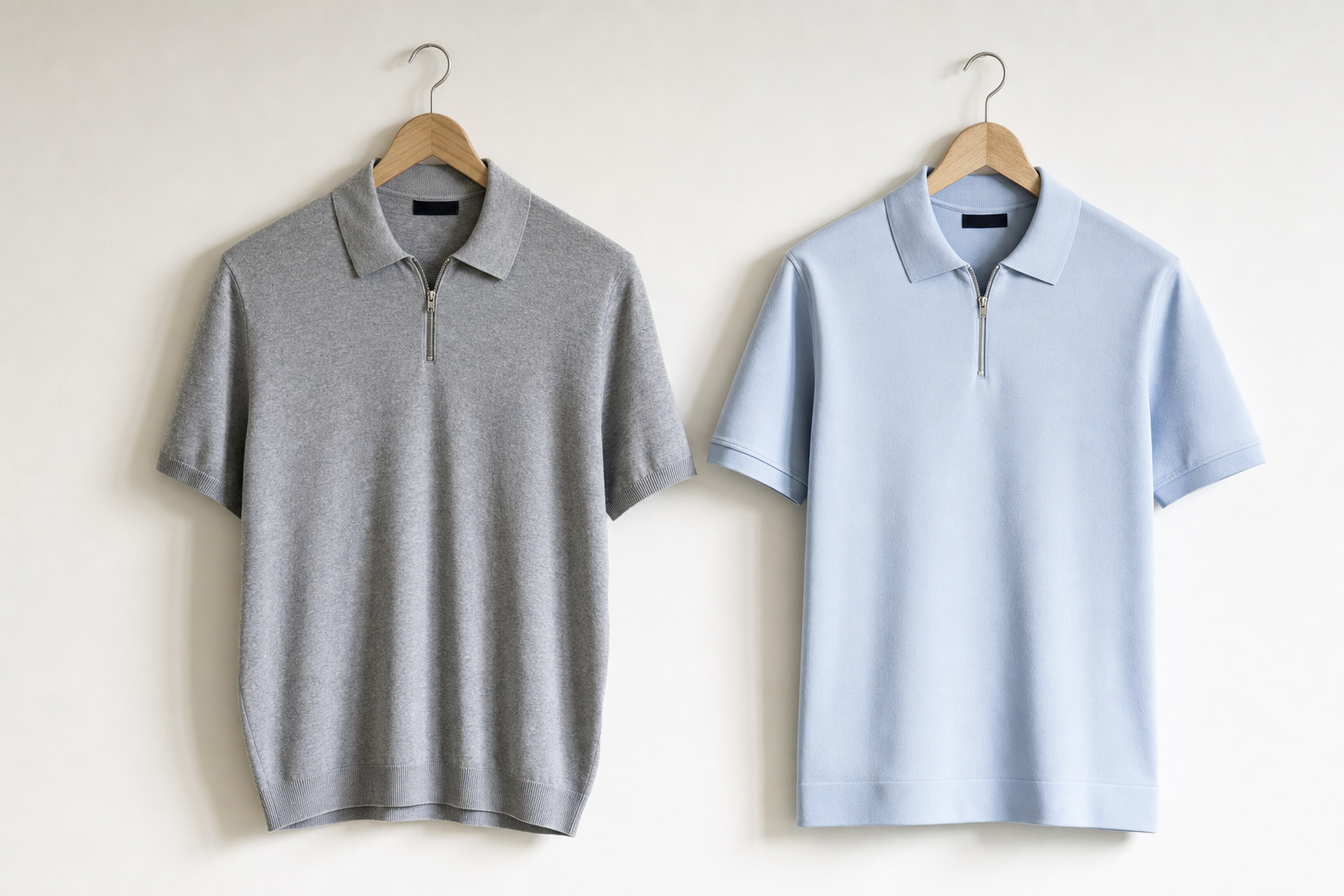
They are both polo shirts. They are both short-sleeve collared knits. They cost roughly similar amounts, they photograph the same, and from three metres away you genuinely cannot tell them apart. But hold them, move in them, or look at them from one metre, and the distinction becomes immediately obvious — and it matters.
This is the drape question. And drape, in menswear, is the reason why two shirts that look identical on a website can feel completely different when you're wearing one of them at a dinner table.
The Two Fabrics, Up Close


Fine Knit
Fine knit is exactly what it sounds like: cotton yarn knitted in a continuous loop structure, similar in construction to a jersey t-shirt but significantly finer gauge. The surface is smooth with a subtle texture — you can see the individual loops if you look closely, but from any normal distance it reads as a clean, slightly textured solid colour.
The defining characteristic is drape. Because the loops are interlocked rather than woven, the fabric has inherent elasticity and weight. It falls from the shoulders in a soft, relaxed curve. It doesn't hold a rigid shape. The collar, if unlined, will roll slightly rather than sitting completely flat. This is not a flaw — it is the quality that makes a fine-knit polo look relaxed and considered rather than stiff.
Pique
Pique is a woven fabric. The distinctive raised waffle or diamond grid is created by a complex weave pattern that forms small raised cells in a regular geometric grid across the surface. Run your finger across pique fabric and you feel the ridges between the cells; run your finger across fine knit and it slides smoothly.
Because pique is woven rather than knitted, it holds its shape with much greater rigidity. The collar of a pique polo lies flat and stays flat. The front placket has no roll. The overall garment keeps its structure whether you're wearing it or hanging it on a hanger.
The Drape Test

Hang them side by side on wooden coat hangers against a plain wall and take a step back. The knit polo falls from the shoulders in a soft V — you can see the fabric weight pulling it slightly at the sides. The collar drapes open. There's movement in the fabric even when it's stationary.
The pique polo is different. It hangs more like a woven garment. The collar lies flat and stays there. The body of the shirt is more uniform — less ripple, more consistent silhouette. It looks tidier on the hanger. It looks more structured on the body.
Neither of these is better. They are for different contexts and different preferences.
When to Wear Each
| Context | Fine Knit Polo | Pique Polo |
|---|---|---|
| Evening restaurant | Better — drape reads as relaxed luxury | Fine, but reads slightly sportswear |
| Office smart casual | Better — structure without stiffness | Works if collar stays neat |
| Weekend outdoor | Both work equally | Both work equally |
| Golf / sport | Not ideal — less moisture-wicking structure | Better — designed for movement |
| Layering under blazer | Better — smooth collar doesn't create bulk | Works but collar ridge can show |
| Tucked formal setting | Better — knit tucks cleanly, holds well | Can bulk at the waistband |
The Squalo Roma Approach
Squalo's polo range is built on fine knit, not pique. This is not an accident. Pique was designed for the golf course in the 1920s and has been fighting that context ever since. Fine knit has no such baggage — it arrived as Mediterranean casual wear and stayed there. It photographs better under warm light, holds its drape through a full evening, and layers more cleanly under an unstructured blazer.
The Tailored Knit Polo is the reference point: 12-gauge cotton in a shade that works from noon to midnight. The Fine Knit Polo runs a slightly lighter gauge for warmer seasons — still structured at the collar, still enough weight to drape without clinging.
If you own one pique polo and are wondering whether to replace it with a knit version: yes. The knit goes more places with less visible effort.
Frequently Asked Questions
Is a knit polo smarter than a pique polo?
For most non-sport contexts, yes. Fine knit reads as a considered, slightly elevated fabric choice. Pique reads as active or sport-influenced, regardless of how it's styled. The exception is a very crisp white pique polo, which has its own formal code — but it's a specific item, not a general-purpose polo.
Does fine knit polo wrinkle more than pique?
No — fine knit actually wrinkles less. Because the structure is elastic (interlocking loops), the fabric recovers from compression more readily than woven pique. Pique can crease at the sides when you sit for extended periods; fine knit releases these more easily. This is one reason it's better for long evenings.
Can you play golf in a fine knit polo?
You can, but it's not designed for that. Pique polo was engineered for the range of movement and moisture management golf requires. A fine-knit polo will perform adequately but the fabric is heavier and less ventilated than performance pique. For sport: wear pique. For everything else: wear knit.
How should a polo collar look when worn?
One button undone for smart casual. Two buttons undone for casual outdoor. Collar should lie flat on pique; on fine knit, a very slight natural roll at the collar tips is normal and correct — it's the fabric behaving as intended. Forced-flat looks like you pressed it with too much effort.
Further reading: What is a knit polo? A complete guide to the fabric and the garment — and how to style a knit polo across different occasions.
See Squalo's linen and knit polos, made to wear back to linen trousers. Take a whole outfit at Shop the Look.
See also: The Knit Polo: what it is and how to wear it.


