
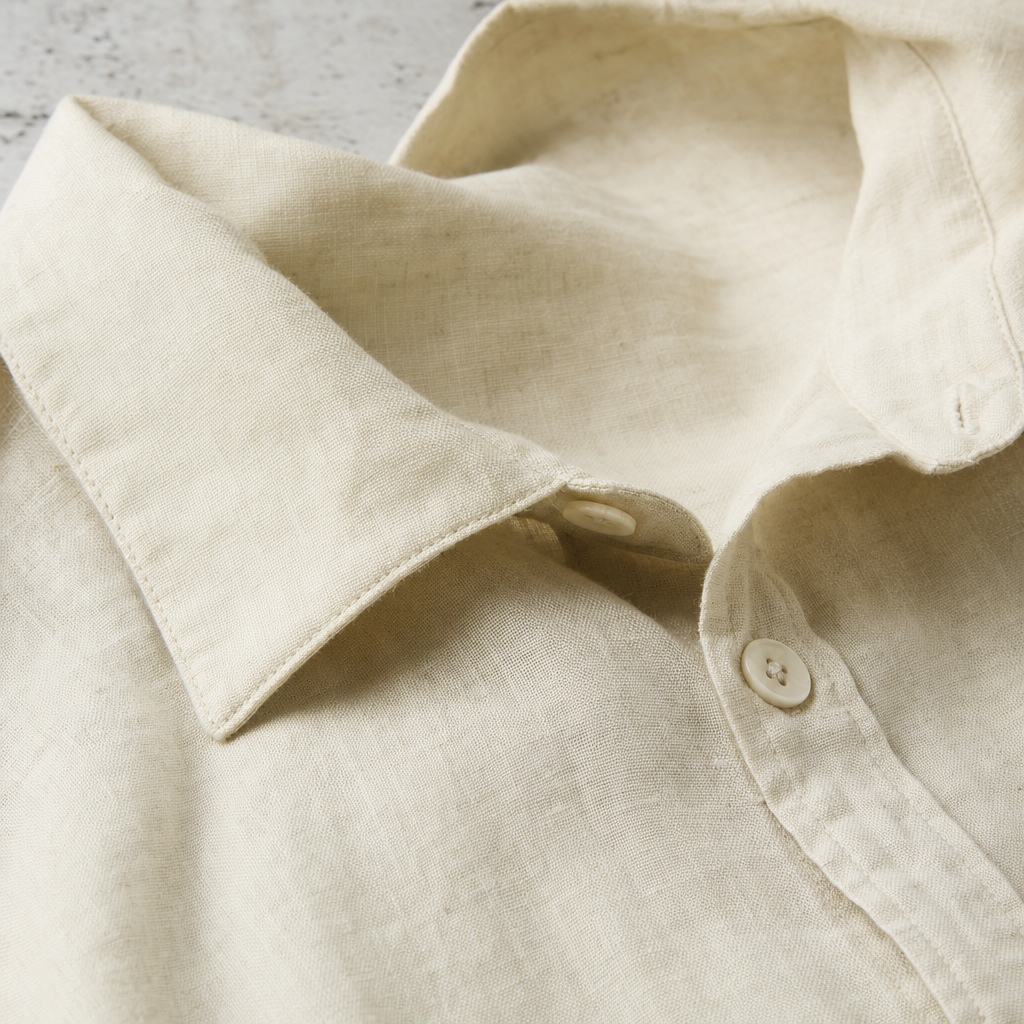
Three things genuinely justify a $200 linen shirt over a $70 one: the fibre quality (long-staple linen from specific European growing regions versus commodity linen), the construction depth (hand-rolled hems, French seams, linked collars versus standard overlock), and the cut (made to drape rather than merely fit). Nothing else is real. A brand name is not a justification. Italian manufacturing is a proxy for construction depth, not a guarantee of it. If you can identify these three elements in the $200 shirt and cannot find them in the $70 alternative, the premium is real. If you cannot, it is not.
You have the two shirts in your hands. One is $69, the other is $220. The fabric feels different — the expensive one is softer, more fluid, slightly cooler to the touch. The collar construction is different — one has a folded and stitched collar; the other has a collar with a rolled edge, each stitch individually set. You turn them inside out. One has flat-felled seams; the other has overlocked seams that are perfectly adequate. These differences are real. The question is whether they are worth $151 to you.
What is long-staple linen and why does it matter?
Linen fibre length determines the quality of the resulting yarn. Long-staple linen (fibres over 60cm) produces a smoother, finer, stronger yarn that can be spun at higher counts (finer threads per centimetre). Belgian and Irish linen has traditionally commanded premium prices because their wetter climates produce longer, finer fibres than Mediterranean or Eastern European growing regions. A shirt labelled "Belgian linen" or "Irish linen" uses these longer staples; the result is a fabric that is softer to start and softens further with washing rather than roughening. Most $70 linen shirts use commodity linen — perfectly functional, but the fibre length, and therefore the fabric quality, is lower.
What construction details justify a higher price?
| Detail | Standard ($70 shirt) | Premium ($200 shirt) | Difference |
|---|---|---|---|
| Seam finish | Overlock stitch | French seam or flat-felled | Durability, clean interior |
| Hem | Folded and stitched | Hand-rolled or single needle | Drape, visual refinement |
| Collar | Standard interlining + machine stitch | Soft interlining, hand or single-needle finish | Drape, shape retention |
| Buttons | Plastic or resin | Mother-of-pearl or corozo nut | Feel, visual quality |
| Allowances | Standard seam allowances | Generous seam allowances for alteration | Longevity, repairability |

When is the $200 shirt not worth it?
When the premium is for the brand name rather than the construction. Several heritage brands sell linen shirts at $150–$250 that, on inspection, have the same overlock seam construction and commodity linen as shirts at $70. The price premium in these cases is entirely brand equity — the name on the label — and is not reflected in the garment. The test: turn the shirt inside out and examine the seam finish. If you see overlocked seams at $200, you are paying for the label. This is not a wrong choice if the brand equity matters to you; it is a wrong choice if you are paying the premium for craft.
Is a $70 linen shirt worth buying?
For most buyers, a quality $70 linen shirt — Squalo Roma at $69 is the honest example — provides 80–90% of the functional value of a $200 shirt. The fabric is honest linen at a wearable weight; the construction is clean and durable; the cut is designed for the use case. What it does not offer is the long-staple Belgian linen softness, the hand-rolled hem, or the mother-of-pearl buttons. These are real differences. Whether they are worth $130 is a personal question. For a wardrobe builder: start with the $70 shirt, confirm the lane suits you, then invest in the $200 version when you know you will wear it for ten years.
Frequently asked questions
Is Luca Faloni linen worth $220?
For the specific construction they offer — Italian manufacturing in Castel Goffredo, long-staple linen, traditional collar construction — yes. This is a credentialed price for credentialed goods. The alternative is not $70 across the board; it is $70 for the look and $220 for the object. Both are valid choices for different buyers.
Does more expensive linen last longer?
Yes, with caveats. Long-staple linen with French seams and generous seam allowances for alteration will outlast commodity linen with overlocked seams under equivalent care conditions. The difference over ten years of wearing is real. The caveat: all linen benefits from the same basic care (cool wash, hang dry), and a $70 shirt properly cared for will outlast a $200 shirt run through a dryer.
Can you tell linen quality by touching it?
To a degree. Long-staple linen has a cooler, smoother hand than commodity linen — it feels almost silky when new and becomes softer with washing. Commodity linen can feel slightly rough when new and may stay rough after repeated washing (it depends on the finishing process). The most reliable test is actually watching the drape: high-quality linen falls in a fluid, continuous line; lower-quality linen drapes with small irregular breaks in the fall of the fabric.
Read next: Old Money Style for Men and Men's Linen Trousers.


