
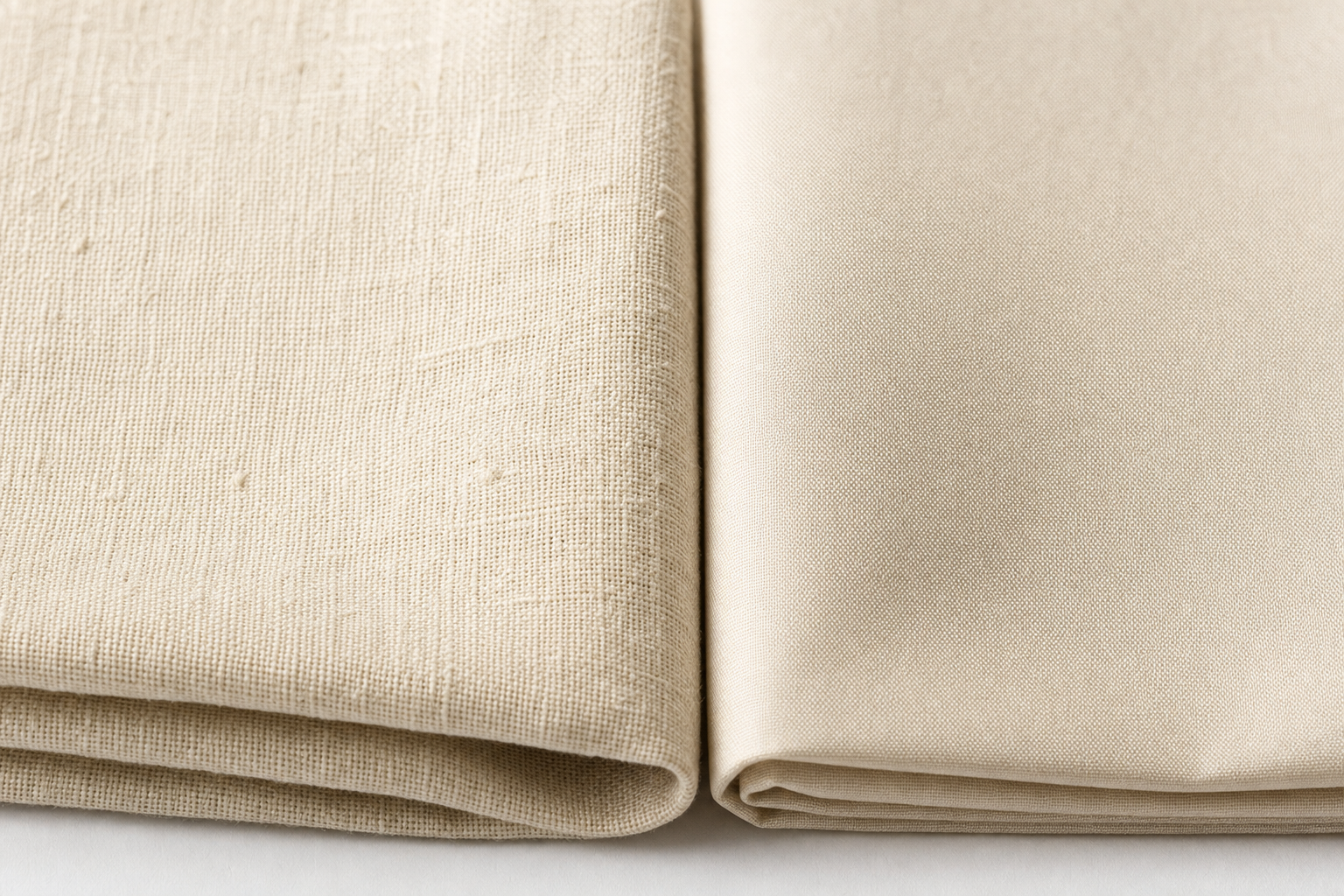
The question gets asked in July, in the fitting room, when it's already too hot to think carefully about fabric. Linen or cotton? The short answer is: above 23°C, linen. Below that, cotton poplin. But the longer answer explains why, and the longer answer is useful.
The Fabrics, Side by Side


Why linen breathes faster
Linen breathes faster than cotton for two structural reasons. First, the weave is looser — you can see this in the side-by-side and in the backlit comparison above. Loose weave = more air movement against the skin. Second, linen fibre has a flat cross-section with a hollow core, while cotton fibre is round. The flat linen fibre conducts heat away from the body more efficiently. The result: in identical heat conditions, wearing linen feels two to three degrees cooler than wearing cotton, not because the temperature changes but because heat transfers faster.
Why cotton is easier to manage
Cotton poplin has a tighter weave, which means it holds its shape better, wrinkles less severely, and responds better to ironing. Cotton also accepts dye more uniformly — the natural slub variation in linen means dye takes unevenly, which gives linen its characteristic slightly mottled look in solid colours. For formal settings where a shirt needs to maintain crispness over a full day, cotton poplin is often the correct choice.
The Heat Decision
| Temperature | Winner | Why |
|---|---|---|
| Below 18°C | Cotton | Linen doesn't insulate; cotton poplin holds warmth better in cool conditions |
| 18-22°C | Toss-up | Both are comfortable; cotton will be crisper, linen more relaxed in feel |
| 23-28°C | Linen | Heat differential becomes meaningful; linen's open weave matters here |
| 28°C+ | Linen clearly | Cotton traps heat and shows sweat faster; linen wicks and dries more quickly |
The Wrinkle Question
Linen wrinkles more than cotton. This is not a flaw — it is a property of the fibre. Flat linen fibres bend and stay bent when compressed; round cotton fibres spring back more readily. The practical difference: a linen shirt that has been sitting in a bag will come out more creased than a cotton poplin shirt. A linen shirt that has been worn for two hours will show more crease marks at the usual compression points (elbows, waist, where you've been sitting).
Whether this matters depends entirely on context. For a relaxed summer afternoon, a café, a terrace, a harbour walk — linen that is slightly worn-in looks exactly as it should. For a long day of client meetings that ends in a dinner: cotton poplin is the more professional choice, because it will still look composed at 7pm in a way linen won't without a change.
Long-term: Which Wears Better?
Linen gets better with age. The fibres soften with repeated washing, the hand improves, the drape becomes more pronounced. A linen shirt after 50 washes is typically softer and more comfortable than it was new. Cotton poplin tends to thin and pill at wear points over repeated washing — it's more consistent over the first five years but declines after that.
For a shirt you intend to keep and wear for a decade: linen. For a shirt you need to look perfect for the next two years and replace: cotton poplin.
Squalo Roma's Position
Squalo's shirt range is built around linen for summer, and fine knit for year-round. The linen shirts are midweight (the range that breathes well in the heat while holding enough body to look considered): Linen Long Sleeve Shirt in five colours, Linen Short Sleeve Shirt for the open-over-swim-shorts context. We don't make cotton poplin shirts because in the summer heat context where Squalo operates, linen is the correct answer to the question.
Frequently Asked Questions
Is linen or cotton better for summer?
Above 23°C, linen is better. The open weave and fibre structure of linen conducts heat away from the body faster, breathes more effectively, and wicks moisture more readily than cotton poplin. The tradeoff: linen wrinkles more significantly and requires more care in handling.
Does linen keep you cooler than cotton?
Yes, measurably. The combination of linen's open weave (allowing more air movement) and the flat fibre structure (conducting heat away from skin faster than round cotton fibres) creates a cooling effect that becomes particularly noticeable above 25°C. In air-conditioned environments, the difference is less significant.
Is linen harder to care for than cotton?
No — both are machine-washable, both dry easily. Linen wrinkles more in the wash and requires more attention when drying (shake out before hanging) but it doesn't require more careful handling or special detergents. See the full linen care guide.
Can I wear linen to a formal event?
For outdoor summer formal events (garden parties, outdoor weddings, summer lunches): yes. For indoor formal events (evening black tie, formal office): a linen shirt in midweight will work for "smart casual" dress codes but reads less formal than cotton poplin. See the summer wedding outfit guide for specific occasion dressing advice.
Related: Complete linen shirt guide — Mediterranean summer wardrobe.
Looking for linen worth the care? See Squalo's linen trousers and knit polos, or a full outfit at Shop the Look.
See also: Summer business casual for men.
Read next: Men's Linen Trousers.


