Quiet luxury is not a new concept. It is a very old concept that periodically gets a name. The idea: quality chosen for its own sake, not for its signals. Clothing that costs more than average because it is made better than average, not because of a logo or a campaign.
The problem is that "quiet luxury" has been annexed by marketing to describe things that are not quiet and are not particularly luxurious. This is a guide to what it actually means — and what the brands that genuinely occupy this space look like compared to those that are borrowing the vocabulary.
What Quiet Luxury Actually Means

Quiet luxury is visible at one metre, not ten. The logo is absent or so small it requires deliberate attention. What does the signalling instead: the weight of the fabric, the way it falls from the shoulders, the handle of the buttons, the stitching at the collar.
The corozo button in the photograph above is a classic example. Most men couldn't name it, couldn't tell you why it looks different from a plastic button. But they register the difference. The surface variation in a real shell button — no two identical — reads subconsciously as quality. This is what quiet luxury is: the accumulation of details that don't announce themselves.
The fabric test
Hold the garment by the shoulder seam and let it fall. Does the fabric drape softly downward, following gravity cleanly? Or does it stiffen, hold a shape that isn't its own, push back against the fall? Quality natural-fibre garments drape. Fast fashion blends stiffen.
The seam test
Turn the garment inside out. Are the seams clean and flat, or are they bulky and rough-cut? Are there loose threads? Is the lining (if any) attached cleanly at the hem? Seam quality is the fastest indicator of manufacturing standard.
The hand test
Rub the fabric between your fingers. Does it have warmth? Natural fibres — wool, cotton, linen, silk blends — retain body heat briefly and feel alive under friction. Synthetic blends feel cooler and slightly slick. This is a physical property, not an aesthetic one.
The Drape Argument

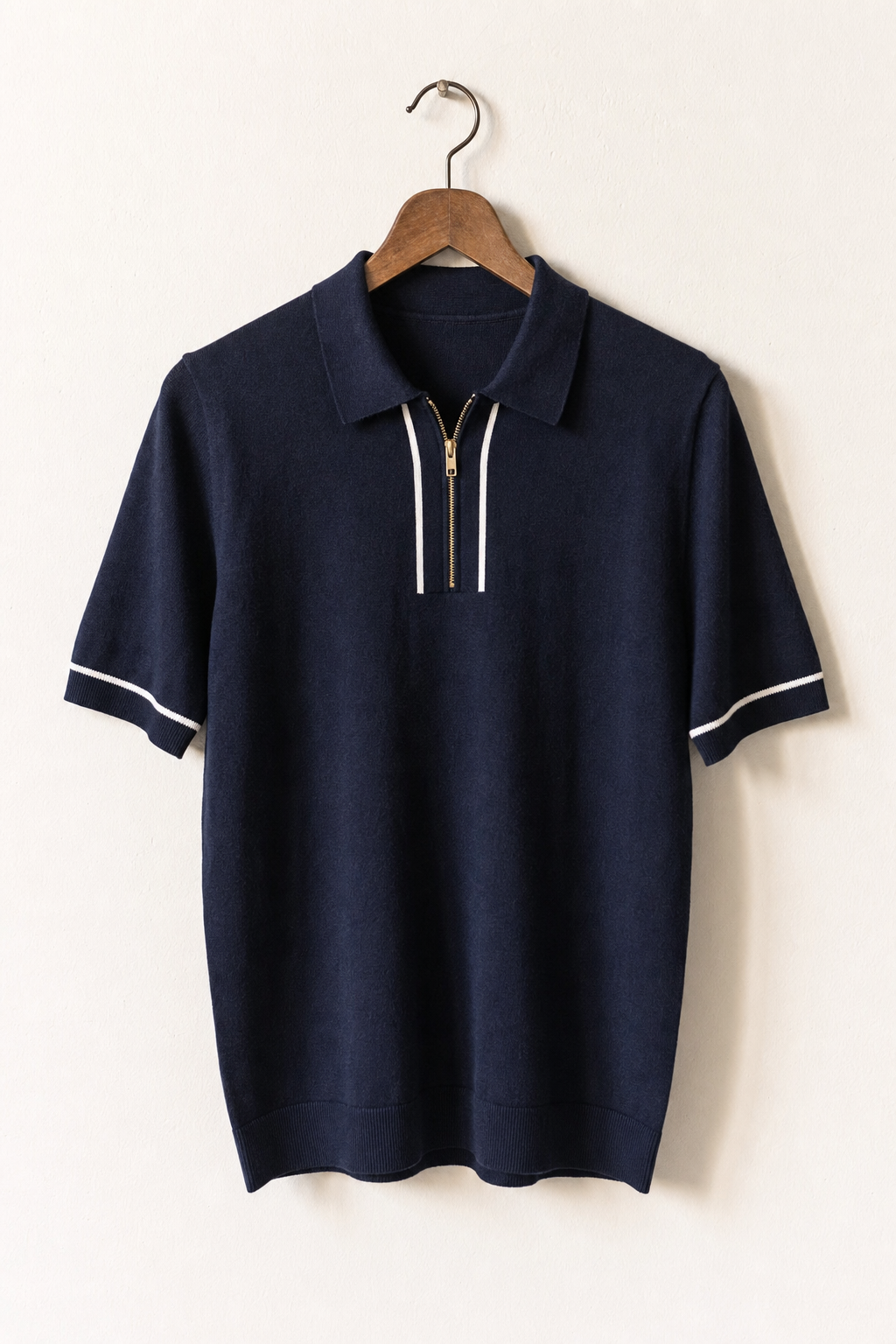
Hang this shirt on a hanger and step back three metres. The shoulders are wide enough to sit on the hanger without pulling inward. The fabric falls in a clean line from the shoulder to the hem, with a slight natural weight that creates a barely-perceptible V-shape as the body of the shirt narrows to the hem. The collar drapes open at the front. There is no stiffness, no pushing back against gravity.
This is the Tailored Knit Polo in navy. The drape is not an accident — it is a function of the yarn weight, the knit gauge, the cut, and the finishing. A polo in a synthetic blend, or one with a cheaper cotton yarn, would behave differently from the same hanger: it would hold its shape in a slightly stiffer way, the collar would not fall naturally, the hem would kick out rather than fall straight.
None of these differences are loud. They register at the margin — the difference between a shirt that looks like you tried and a shirt that looks like you didn't need to.
The Map of the Lane
| Brand | Position | Price point (polo) | What it means |
|---|---|---|---|
| Loro Piana | Top of the lane | €400-€800 | Wool and cashmere; fabric provenance as part of the proposition |
| Brunello Cucinelli | Top of the lane | €500-€900 | Cashmere, human manufacturing cost reflected in price |
| Luca Faloni | Mid-upper | €200-€350 | Italian manufacturing, merino and linen focus |
| Percival | Mid | £120-£180 | British brand, fine knit focus, good construction |
| Squalo Roma | Mid-access | $49-$89 | Fine knit and linen, Mediterranean focus, no branding premium |
| Fast fashion "quiet luxury" | Borrowing vocabulary | $25-$50 | The aesthetic without the construction; registers differently at one metre |
The honest map of this lane is that there are genuine tiers within "quiet luxury." The Brunello Cucinelli customer and the Squalo Roma customer are not making the same purchase — they are making proportionally similar investments relative to what they're getting. The Brunello polo is priced as it is because of cashmere sourcing, Italian artisanal production, and a manufacturing floor where makers are paid significantly above average. The Squalo polo is priced as it is because we don't carry a brand premium and the production volume allows better economics without compromising the construction that matters.
What they share: the drape test passes on both. The seam test passes on both. The logo is absent or minimal on both. These are the properties of the lane, not its price.
What to Buy First
If you're building a quiet-luxury wardrobe from scratch, the order of priority is not hard to determine. The question is: what am I currently wearing in its place, and does that thing pass the one-metre test?
- One fine knit polo in navy. The versatile anchor. Replaces three different shirts in the wrong register. Tailored Knit Polo.
- One linen shirt in beige or white. The summer anchor. Replaces cotton shirts that trap heat and look careless by noon. Linen Long Sleeve Shirt.
- One pair of linen trousers. The bottom that doesn't compete with either of the above.
These three items cover the range from relaxed afternoon to smart-casual evening without requiring additional purchases. Start here before buying anything else in this register.
Frequently Asked Questions
What is quiet luxury in menswear?
Quiet luxury describes clothing that signals quality through construction, fabric, and fit rather than logos or branding. It is not a specific aesthetic or colour palette — it is a set of material decisions: natural fibres, clean construction, minimal branding, clothing that earns attention at one metre rather than ten. The opposite of quiet luxury is logomania or fast fashion branding — items that signal status through the brand mark rather than the garment itself.
What brands are genuine quiet luxury?
Genuine quiet luxury brands include Loro Piana, Brunello Cucinelli, Luca Faloni, Percival, and in the accessible tier, Squalo Roma. The test is whether the garment passes the drape, seam, and hand tests above — not whether the marketing uses the phrase. Many brands have adopted the aesthetic without the construction.
Is quiet luxury expensive?
The construction properties of quiet luxury don't have to be expensive — they have to be present. A €25 polo can pass the hand test; most don't because the margin required at that price point doesn't allow for the fabric or construction choices. But a €80-€120 garment from a brand without a branding premium can deliver construction equivalent to pieces priced three times higher from brands with large marketing costs. The question is what the price is paying for.
What colours are quiet luxury?
Muted, natural tones — navy, stone, cream, beige, warm white, forest green, burgundy. These colours don't shout. They read as intentional in any context and photograph well. Loud saturated colours, heavy branding graphics, and maximalist patterns are the visual opposite of quiet luxury regardless of the fabric underneath.
This is the hub article for the Comparison pillar. Related: what is a knit polo — the linen shirt guide.
See also: Old Money Style for Men.
Read next: Old Money Style for Men and Modern Business Casual.


